2 min read

A quick guide for ESEF 2025 updates – CtrlPrint makes compliance effortless

A quick guide for ESEF 2025 updates – CtrlPrint makes compliance effortless

ESMA has released the updated ESEF Reporting Manual for year 2025 reporting. The latest edition introduces a few clarifications and tighter interpretations of existing guidelines, but no radical changes – meaning  your reporting process will remain familiar and consistent.

At CtrlPrint, we make sure even small regulatory updates don’t slow you down. Our tools are fully aligned with the new technical requirements, allowing you to continue your ESEF reporting with confidence, accuracy, and ease.  

We’ll also be hosting two ESEF reporting training sessions on November 4 and 6, where we’ll guide you through every step of the process. [Book your spot here]

Below, you’ll find a summary of what’s new and what to keep in mind when preparing your 2025 reports.

Highlights from the updated manual & CtrlPrint guidance

  • IFRS tags not yet in ESEF taxonomy (Guidance 1.2.1 & 1.2.2)
    If your company needs to use IFRS tags that have not yet been adopted by the EU or implemented in the ESEF taxonomy, please refer to the manual for specific instructions.

→ CtrlPrint article: How to Create Tags For Elements From the IFRS Taxonomy

  • Anchoring extensions (Guidance 1.4.1)
    When anchoring extensions, an extension element should be anchored to a core element with the same or a more restricted datatype.

Example: Anchoring a monetaryItemType to a monetaryItemType or Anchoring nonNegativeMonetaryItemType to a monetaryItemType

→ CtrlPrint article: Creating an Extension

  • Dates (Guidance 2.1.2)
    The date elements (startDate, endDate) must identify periods using whole days without a time or time zone component.

→ CtrlPrint comment: All dates are automatically whole days in CtrlPrint XBRL Tagger.

For instant period types, preparers must use the period-end date (e.g., 202X-12-31).

→ CtrlPrint comment: This is particularly relevant for Cashflow statement and the changes of equity statement where there are both opening and closing balances. The period refers to the closing balance for the day, which is the same as the opening balance for the following period. For this reason, the opening balance for January 1, 2025, for example, is marked with the date 2024-12-31) 

→ CtrlPrint article: Statement of Changes in Equity Guidance

  • Dashes, nils and empty cells (Guidance 2.2.5)
    Empty cells that represent a value of zero (e.g., shown as “–”, “n/a”, or blank) should be transformed to “0”. Rounded values below the scale should display “0”. Comparatives should not contain empty cells in one period if they have a value in another—these should also be tagged as “0”.

→ CtrlPrint comment: CtrlPrint XBRL Tagger does not allow tagging empty cells. This is because there is a difference between zero and empty. We recommend using e.g. "-" in places where you want to indicate zero.

  • @escape attribute (Guidance 2.2.7)
    The logic around the @escape attribute is now more nuanced. While “true” remains mandatory for textBlockItemType, it should only be applied to other types (such as stringItemType) when the content includes special characters (e.g., < or &).

→ CtrlPrint comment: @escape attribute is by default “true” in Ctrlprint Tagger for textblock tags and “false” for other tag types, but can be adjusted by user if needed.

  • Version number in the package name (Guidance 2.6.3)
    The recommended naming convention for the {version} component of a report package has been updated. The first submission should now always use “1”, instead of “0”.

→ CtrlPrint comment: Package naming is created automatically when the package is created. Version number among other name elements can be adjusted in CtrlPrint XBRL tagger settings.

→ CtrlPrint article: Download an XBRL Report

  • Calculations (Guidance 3.4.1)
    The manual now explicitly states that issuers shall use Calculations 1.1 relationships and the associated summation-item arcrole, removing previous ambiguity between “recommended” and “shall apply”.

→ CtrlPrint comment: CtrlPrint XBRL Tagger uses Calculations 1.1 relationships.

It is also worth noting that reports for financial year 2025 will be prepared using the ESEF 2024 taxonomy.

Upcoming CtrlPrint ESEF webinars

To help you prepare for the 2025 reporting season, CtrlPrint will be hosting a series of ESEF Tagging Kick-off and Walkthrough 2025 training sessions during the first week of November.

There will be two sessions:

  • The first will focus on tagging of primary financial statements.
  • The second will cover text block tagging and the finalisation of your report.

You can secure your seat and get a recording of each training here!

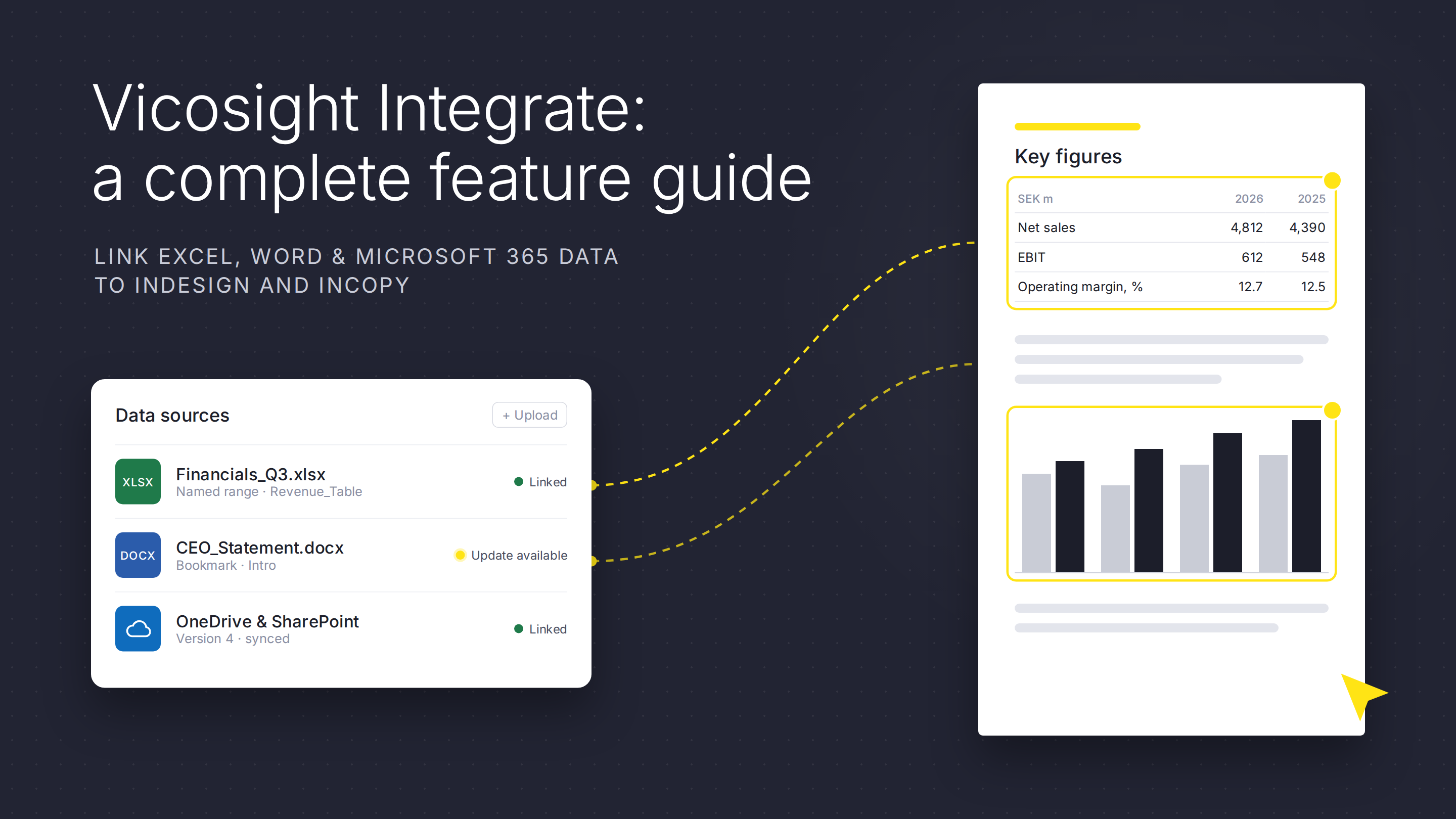
Vicosight Integrate: a complete feature guide

Vicosight Integrate: a complete feature guide

Vicosight Integrate is a data connectivity feature that enables you to link data sources directly to your InDesign and InCopy documents, reducing...
Read More
Vicosight Integrate: Chart Studio and other updates

Vicosight Integrate: Chart Studio and other updates

Over the past several months, Vicosight Integrate has received a series of updates introducing new capabilities and improvements to data handling,...

Read More
Crafting Vicosight new brand identity: evolving a 25-year legacy in corporate reporting

Crafting Vicosight new brand identity: evolving a 25-year legacy in corporate reporting

CtrlPrint has officially transformed into Vicosight, evolving from a trusted production tool into a modern digital ecosystem. Transitioning a 25-year...

Read More
What is ESEF (European Single Electronic Reporting)?

What is ESEF (European Single Electronic Reporting)?

Learn about ESEF regulations, the importance of ESEF taxonomy and tagging, and how CtrlPrint helps companies produce compliant digital financial...

Read More
IFRS 18 and the ESEF 2025 taxonomy: what changes, and when?

IFRS 18 and the ESEF 2025 taxonomy: what changes, and when?

Discover the key changes brought by IFRS 18 and the ESEF 2025 taxonomy, including impacts on financial reporting and tagging strategies for companies.

Read More
The perfect reporting year from an agency perspective

The perfect reporting year from an agency perspective

CF Report's perspective on the reporting year We asked one of our partner agencies, CF Report, to reflect on how they see the changes in the...

Read More