SBR taxonomy in Finland: iXBRL tagging for PRH filing with Vicosight
The SBR taxonomy is Finland's national XBRL taxonomy for financial statements prepared under Finnish GAAP (FAS). With Vicosight, you tag your report...
5 min read
Vicosight : Published
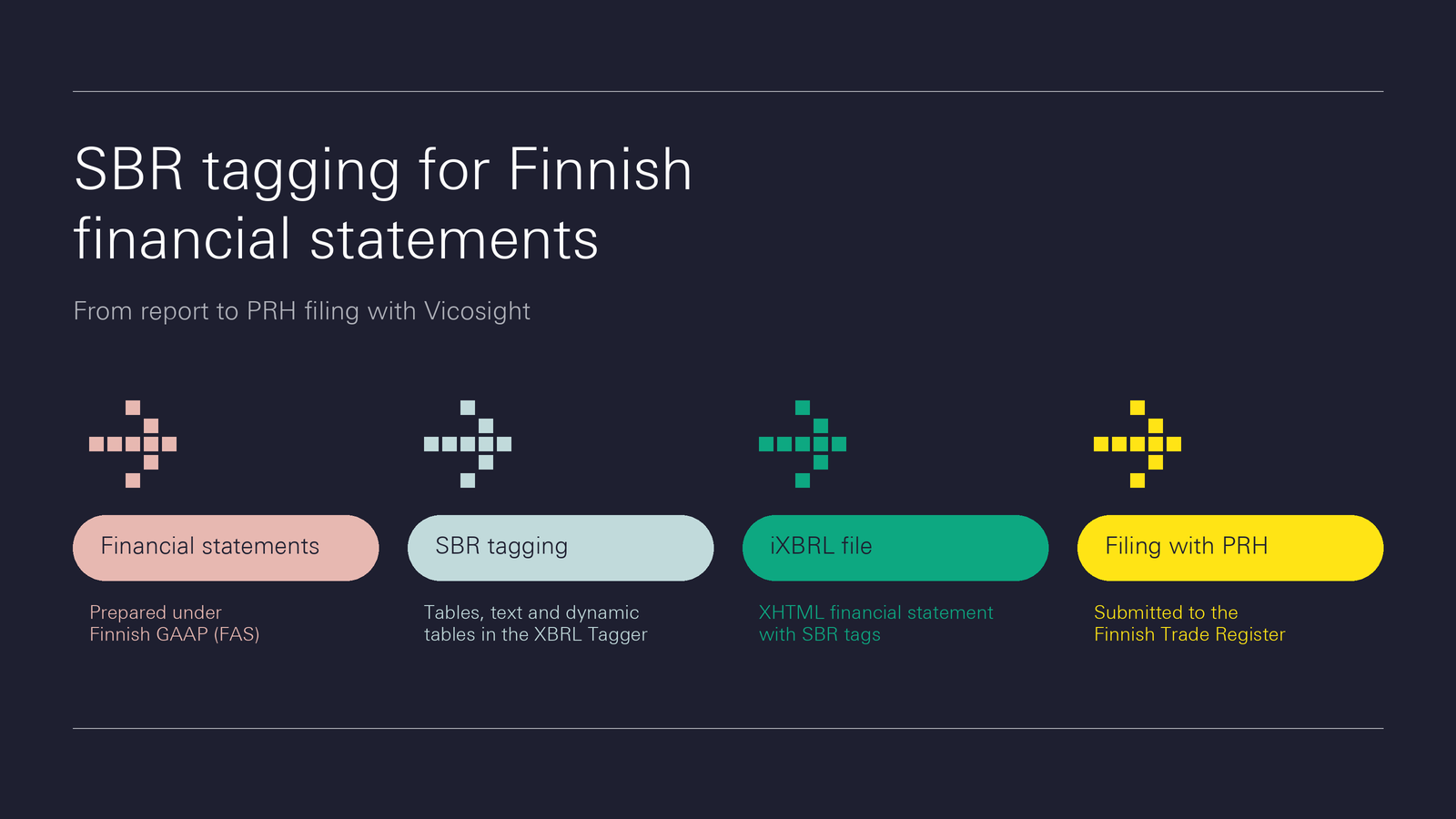
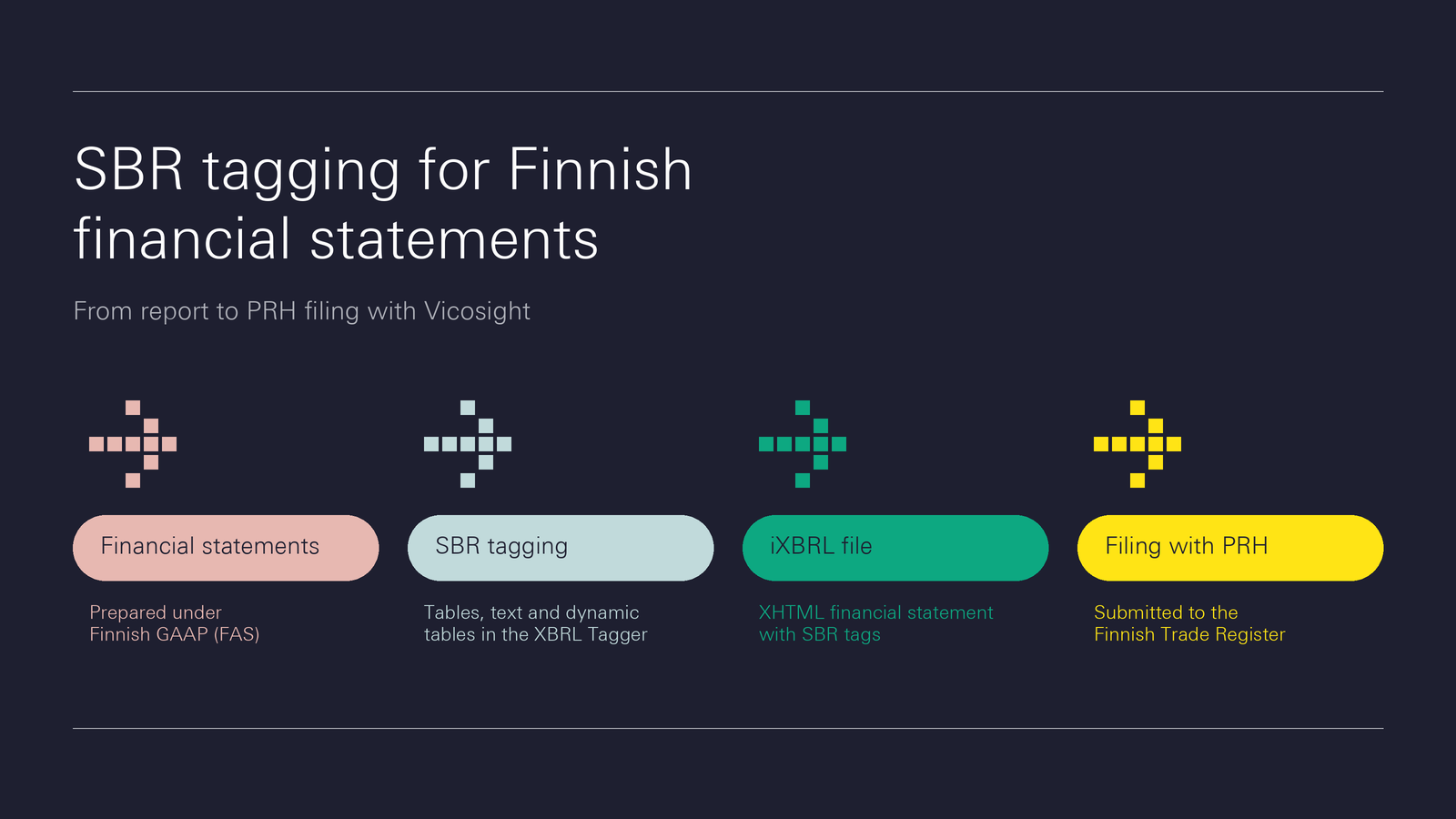
The SBR taxonomy is Finland's national XBRL taxonomy for financial statements prepared under Finnish GAAP (FAS). With Vicosight, you tag your report with the SBR taxonomy and produce the iXBRL financial statement that the Finnish Patent and Registration Office (PRH) accepts. This guide explains what the SBR taxonomy is, when digital financial statements become mandatory in Finland, and how SBR tagging works in Vicosight. For step-by-step instructions, see the support article Tagging with SBR Taxonomy.
The SBR (Standard Business Reporting) taxonomy is the XBRL taxonomy Finnish companies use to file structured financial statements under Finnish GAAP (FAS). PRH maintains the SBR frameworks for companies and uses them to receive iXBRL financial statements into the Finnish Trade Register. The State Treasury (Valtiokonttori) maintains the frameworks for the public sector. Companies reporting under IFRS use the IFRS taxonomy instead. Listed companies tag their consolidated financial statements with the ESEF taxonomy and their parent company statements with SBR or IFRS, all in one filing package.The SBR taxonomy is built on a Data Point Model (DPM) and a Table Linkbase, not on a hierarchical element tree like the ESEF taxonomy. Its key characteristics are:
Digital financial statements are already mandatory in Finland for companies that publish a sustainability report, from financial year 2026, with first filings in 2027. For other companies, the new law applies to financial years starting on or after 1 July 2027, so their first mandatory filings arrive in 2028 and the rollout runs until 2030 .In 2024, only about 5% of financial statements filed with PRH (about 13,000 of 260,000) were in iXBRL format. The reform covers:
In Vicosight, SBR tagging means mapping your financial statements onto the SBR taxonomy's predefined tables in the Tagger. Each page of your report is a chapter. The XBRL Taxonomy view lists the SBR tables under its Table Linkbase tab.
SBR tagging in Vicosight follows four steps for every type of content:
Vicosight supports three types of SBR tagging: tables, text and dynamic tables.
|
Content |
Used for |
What is different |
|
Tables |
Primary statements and fixed notes |
Map each cell to the template, once per financial year |
|
Text |
Single facts, such as the company name, business ID and reporting period. PRH does not require notes to be tagged as text blocks. |
Highlight the text, then drop the tag onto it |
|
Dynamic tables |
Lists with a variable number of rows, such as shareholdings |
Add rows with Edit Aspects; set Label Column ID to 0 if the first column holds taggable values |
|
Signs |
Negative values and adjustments |
SBR has no debit/credit. Each item has a default sign, published by PRH with the taxonomy: report values that match it as plain numbers (for example, expenses as positive numbers) and use a minus sign only when a value goes against it |
The SBR taxonomy is Finland's national taxonomy for financial statements under Finnish GAAP (FAS), filed with PRH. ESEF is the EU format for listed companies' annual financial reports and is based on the IFRS taxonomy. In Finland, a listed company tags its consolidated financial statements with ESEF and its parent company statements with SBR or IFRS, and files both in one package SBR uses predefined tables, while ESEF uses a hierarchical element tree with calculations.
Companies that publish a sustainability report already tag their financial statements with PRH tags, from financial years starting on or after 1 January 2026. Under the new law, limited liability companies required to appoint an auditor follow from financial years starting on or after 1 July 2027, and the other companies in scope from financial years starting on or after 1 July 2028. The law covers limited liability companies and partnerships whose general partners are all limited liability companies. Cooperatives, housing companies, foundations, associations, credit institutions and insurance companies are not covered. Companies that publish a sustainability report already tag their financial statements with PRH tags
PRH accepts financial statements as XHTML documents with iXBRL tags. PRH decides which items must be tagged: today, the primary statements and a few notes. A report with a taxonomy extension must be filed as a reporting package (.zip); PRH does not accept .xbr or .xbri packages yet.
No. The SBR taxonomy does not support custom calculation relationships. Totals are still checked by PRH's validation rules.
Yes. Vicosight supports SBR dynamic tables, such as shareholdings in other companies, through Edit Aspects.
Yes, in exceptional cases. PRH allows an extension when your financial statements contain an item that no SBR element covers. In the income statement, balance sheet and cash flow statement an extension is then required; in the notes it is optional. Extensions are limited to the accounting code list (the MCY dimension): you can add a new row to a statement, but not new codes to other dimensions, to the report details table (t00) or to enumeration values. Each extension must be anchored to an existing SBR element with a broader or narrower meaning, and it can't duplicate an element that already exists. A report with an extension must be filed as a reporting package (.zip) that includes the extension.
Limited liability companies use the OYTP framework, which also covers cooperatives; LSTP is for credit institutions and investment firms, and VYTP for insurance companies. Within OYTP, choose the individual entry point for the company's own financial statements and the consolidated entry point for group financial statements. Then pick the tables that match how your statements are presented, for example the micro-undertaking balance sheet or the Accounting Ordinance balance sheet, and the income statement by nature or by function. You only use the tables that match your report.
Finnish or Swedish. The financial statements filed with PRH must be in one of the official languages. You can add a translation, for example in English, in the same document or as a separate document in the same reporting package, but it does not replace the official version. Tagged values in a translation must carry the xml:lang attribute.
Start with your primary statements, then move on to notes, text and any dynamic tables.
The SBR taxonomy is Finland's national XBRL taxonomy for financial statements prepared under Finnish GAAP (FAS). With Vicosight, you tag your report...
Reporting teams are under more pressure than ever. They face new regulation, more data points, structured tagging requirements and growing...
In recent years, the audience for corporate reporting has fundamentally changed. While we still write for the human analyst, we are now equally...

Finland mandates digital financial reporting for all companies. Discover the timelines, technical requirements, and how to ensure compliance ahead of...

Compare IFRS with local GAAP standards in Finland, Denmark, and the Netherlands. Understand the key differences and practical implications for...

Discover the key changes brought by IFRS 18 and the ESEF 2025 taxonomy, including impacts on financial reporting and tagging strategies for companies.