1 min read

FAQ: What is the best time to publish a sustainability report?

FAQ: What is the best time to publish a sustainability report?

The short answer: Ideally, your sustainability report should be published simultaneously with your Annual Report. For most companies with a December 31st year-end, this means publication in Q1 or early Q2.

The detailed explanation: Historically, there was a "reporting lag." Companies would release their financial Annual Report in March, followed by a separate Sustainability Report in June or July.

This gap is rapidly closing due to two main drivers:

  1. Regulatory Pressure: Under the Corporate Sustainability Reporting Directive (CSRD) in Europe, sustainability information must be included in the management report section of your Annual Report. This legally binds the publication date of your ESG metrics to your financial filing deadline. While some frameworks like the ISSB offer transitional relief, the clear direction of travel is toward concurrent timing.
  2. Investor Expectations: Stakeholders now view financial and non-financial data as interconnected. Publishing them together signals that your sustainability strategy is core to your business model, preventing the "data drift" that occurs when financial figures are finalised months before sustainability figures.

The Challenge: The "Double Crunch"

Publishing both reports at once creates a massive operational bottleneck. Your Finance, Legal, and Sustainability teams are all trying to edit, review, and sign off on huge volumes of content at the exact same time.

How to manage it: Parallel Workflows

To survive this "double crunch," you cannot rely on sequential workflows where one team finishes before the next begins. You need a parallel workflow.

  • Centralised Collaboration: Use a platform like CtrlPrint that allows Sustainability teams to write the "Non-Financial Statement" while Finance teams work on the "Financial Statements" within the same master layout.
  • Data Linking: Ensure your ESG data tables are linked to your source files (Excel) so that last-minute updates—such as final carbon emission figures—flow instantly into the report without manual re-keying.

By synchronising these timelines, you not only meet compliance requirements but also present a unified, confident narrative to the market.

Request a demo of CtrlPrint here.

How AB Sagax saves about a week per person for each report with Vicosight Integrate

Arvid Rapp, Head of Group Accounting at AB Sagax, shares how Integrate links figures from Excel to the report, saving around 40 hours per report.

Read More

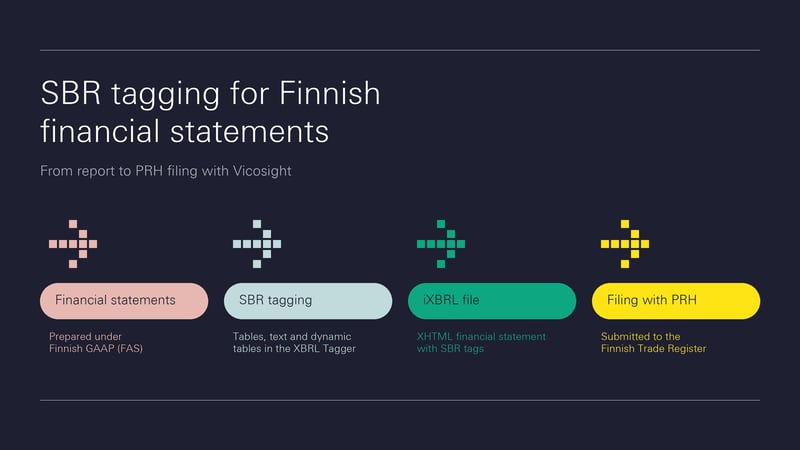
SBR taxonomy in Finland: iXBRL tagging for PRH filing with Vicosight

Discover how to navigate Finland's SBR taxonomy for iXBRL tagging with Vicosight, ensuring compliance for your digital financial statements.

Read More

How is corporate reporting really produced in 2026? Help us find out

Take part in Vicosight’s State of Corporate Reporting 2026 benchmark. 8–10 minutes, anonymous, and every participant can receive the benchmark report.
Read More
Omnibus I, results and new agreements on CSRD: simplified sustainability reporting

Omnibus I, results and new agreements on CSRD: simplified sustainability reporting

European Parliament approves Omnibus I, simplifying sustainability reporting rules, reducing administrative burden, and narrowing the scope of...

Read More
Global reporting cultures converging in the era of digital corporate reporting

Global reporting cultures converging in the era of digital corporate reporting

Discover how global corporate reporting is evolving with digital regulation and structured standards, raising the bar for quality and strategic...

Read More
Deliver best-in-class annual reports: a Vicosight whitepaper

Deliver best-in-class annual reports: a Vicosight whitepaper

Discover how to overcome the complexities of corporate reporting with structured workflows that enhance efficiency, accuracy, and compliance in your...
Read More