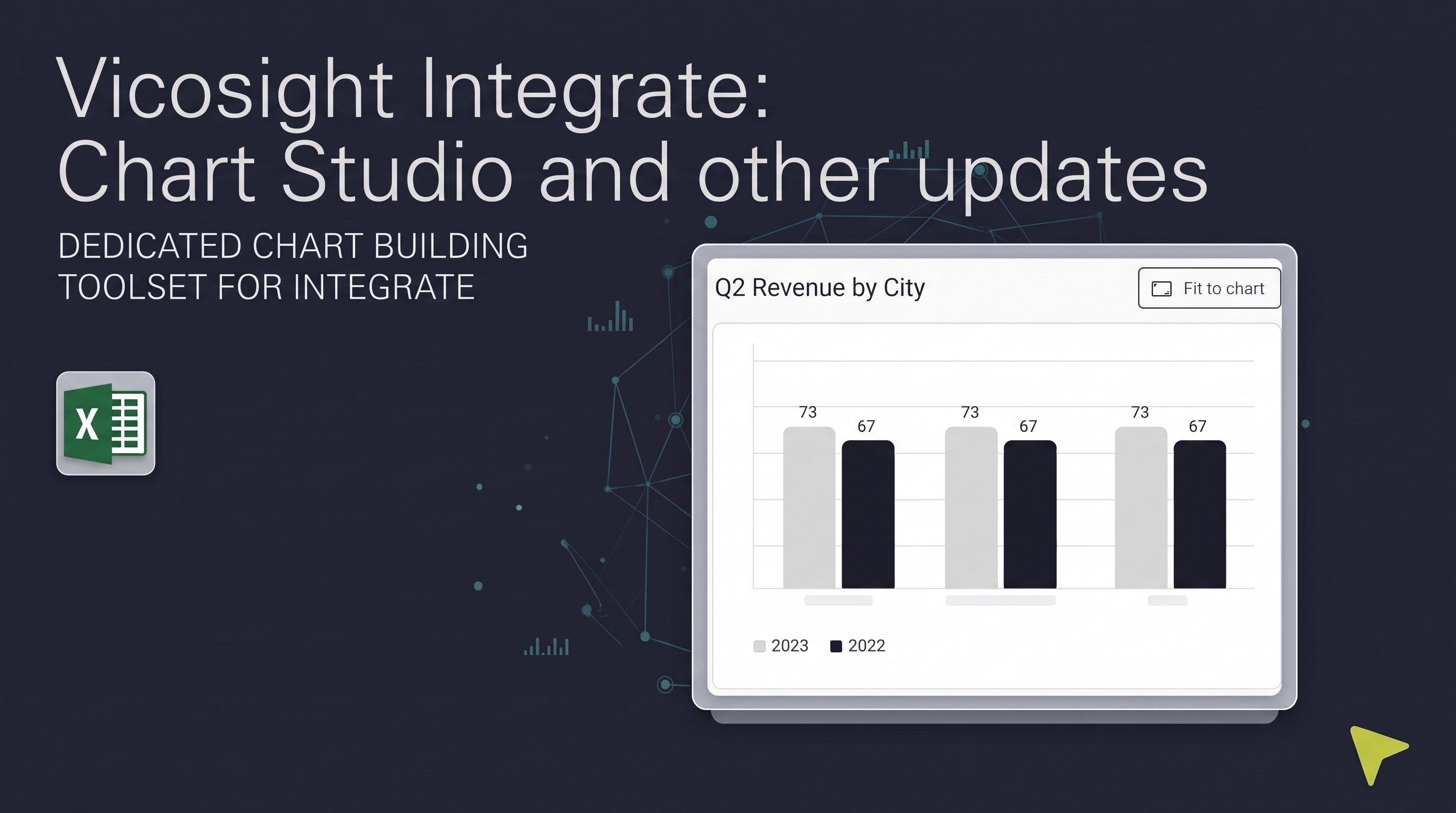
Vicosight Integrate: Chart Studio and other updates
Over the past several months, Vicosight Integrate has received a series of updates introducing new capabilities and improvements to data handling,...
4 min read

Agnes Sundblad : Published Updated
For years, Diversity, Equity, and Inclusion (DEI) initiatives were the loud, proud centrepiece of the Annual Report. CEOs competed to showcase the boldest targets, and “Diversity” was a headline in every investor deck.
Diversity, Equity, and Inclusion (DEI) is a framework promoting the fair treatment and full participation of all people, especially those historically underrepresented.
Why it’s important: DEI drives better business performance and is crucial for talent attraction/retention. Furthermore, investors increasingly use DEI data for risk assessment, and regulations (like the U.S. SEC's disclosure requirements) are standardising reporting. Reporting on initiatives builds accountability and invites scrutiny.
In 2025, the volume of the conversation around DEI was turned down, but the machine is still running – it’s just undergoing a complex re-engineering. Following recent legal rulings and a wave of legislation, corporate leaders are walking a tightrope. On one side, a backlash threatens litigation; on the other, a global workforce demands inclusive workplaces.
We now see a shift from performative declarations to defensive, data-driven, and carefully calibrated reporting.
The most visible trend is semantic. The acronym “DEI” is arguably vanishing from filings, replaced by terms that signal neutrality. “Inclusion” is favoured over “Diversity”; companies are pivoting to focus on “Belonging” and “Talent Engagement”.
The logic is that while “diversity” implies quotas (a legal minefield), “inclusion” implies productivity (a business imperative). This isn't just a marketing gloss; it's a risk mitigation strategy. Legal teams are scrubbing reports for language that could invite a lawsuit, requiring a level of editorial control that standard word processors simply cannot provide.
The result is a shift from activism to business logic.
While headlines suggest a "retreat" from DEI, the numbers tell a different story of integration. Corporate America isn't abandoning these goals; it is quantifying them to insulate against risk.
| Metric | 2022-2023 Trend | 2025-2026 Projection/Status |
| S&P 500 Diversity Disclosure | 95% mentioned "DEI" | 62% now use "Human Capital" or "Belonging" |
| Legal Risk | Minimal private litigation | 25%+ increase in "reverse discrimination" filings |
| Board Diversity | Rapid growth (30%–32% female) | Stabilizing; focus shifted to "skills-based" diversity |
| Pay Gap Reporting | Voluntary & qualitative | Mandatory (CSRD) & quantitative (0.1% precision) |
Here is a deep dive on the above metrics, with related sources:
Based on findings from Harvard Law School Forum on Corporate Governance and surveys by A&O Shearman (2025/2026), In early 2025, research showed a dramatic decline in the term "DEI."
Specifically, only about 34% to 36% of the S&P 500 now use the explicit phrase "Diversity, Equity, and Inclusion" in their 10-K filings, down from over 90% in previous years. 62% of companies still disclose diversity data but have scrubbed the acronym to mitigate political and legal risk.
According to the EEOC (Equal Employment Opportunity Commission) enforcement statistics for FY 2024/2025 and private litigation trackers, following the 2023 Supreme Court ruling on affirmative action, there has been a documented surge in "reverse discrimination" filings and letters from state Attorneys General targeting corporate DEI programs.
EEOC data showed that while overall charges remained steady, retaliation and "merit-based" complaints reached record-high monetary settlements in 2025 ($660M+).
Gender diversity on boards reached a "plateau of maturity," based on The Conference Board and Glass Lewis 2025/2026 Proxy Season Reports.
This confirms the shift we mentioned: boards are no longer "building" the numbers; they are shifting to "skills-based" matrices (cybersecurity, AI, etc.) to justify appointments.
Thanks to the EU Pay Transparency Directive and CSRD (ESRS S1 standards), as of June 2026, EU Member States must have transposed the Pay Transparency Directive. Companies are now legally required to report gender pay gaps with extreme accuracy. If a gap of 5% or more is found and cannot be justified by objective factors, a "joint pay assessment" (essentially an audit) is triggered.
The primary driver for depth in 2026 reporting is the Corporate Sustainability Reporting Directive (CSRD). While US firms may be scrubbing "DEI" from their 10-Ks to avoid domestic political friction, their European operations are now legally required to disclose granular data.
This high-stakes environment creates a massive governance challenge. If your Sustainability team writes one thing in the glossy report and your Legal Counsel deletes it from the 10-K, version control becomes a nightmare. A single discrepancy between these documents can be weaponised by critics on either side.
This is where CtrlPrint acts as the backbone of your reporting governance.
The era of “easy” DEI wins is over. The new era demands rigour, caution, and absolute precision. To survive this transition, your reporting process cannot be a series of loose Word documents emailed between nervous executives. It must be a secure, governed operation.
Request a demo of CtrlPrint here.
Over the past several months, Vicosight Integrate has received a series of updates introducing new capabilities and improvements to data handling,...
CtrlPrint has officially transformed into Vicosight, evolving from a trusted production tool into a modern digital ecosystem. Transitioning a 25-year...
CtrlPrint is now officially Vicosight, and we are not just updating our visual identity, but we are continually looking for ways to enhance the...

Discover how to overcome the complexities of corporate reporting with structured workflows that enhance efficiency, accuracy, and compliance in your...

Discover how global corporate reporting is evolving with digital regulation and structured standards, raising the bar for quality and strategic...
CtrlPrint rebrands to Vicosight, uniting corporate reporting and collaboration in a secure platform that enhances compliance and innovation. Discover...